


Delimitation: Redrawing the Social Contract of India


Priya Chaturvedi
Global Markets Professional, avid reader, finding rhythm in semi-classical dance and expression in Hindi verse.
The recent defeat of the 131st Constitutional Amendment Bill in the Lok Sabha has not silenced the debate on delimitation; rather, it has intensified age-old anxieties over federalism and equitable voting rights.
The current political mood of the country demands a deeper understanding of this exercise.
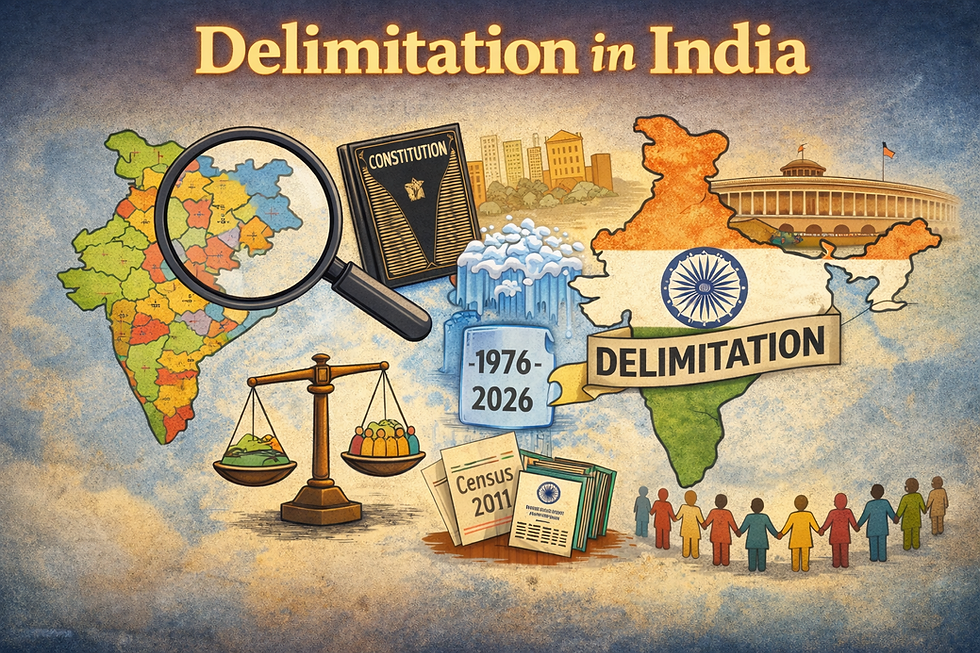
Article 82 of the Indian Constitution, mandates that Parliament enact a Delimitation Act after every Census to redraw the territorial constituencies.
This task is assigned to the Delimitation Commission, a powerful statutory body.
However, the Commission cannot act outside prescribed rules;
it cannot alter the number of seats or change a state's share without a constitutional amendment passed by a special majority in both Houses and ratified by half the states.
The defeated amendment bill sought to address three major areas: lifting the current cap of 550 seats in the Lok Sabha, enabling the Commission to use 2011 Census data (circumventing the 84th Amendment’s requirement to wait for post-2026 data), and introducing a 33% quota for women in direct elections.
The seat count, frozen since 1976 to incentivize population control, is now at crossroads.
The Bill was a mathematical paradox which exploded the absolute seat counts of the north but the pro-rata design (50% increase for all states) ensured that the relative power balance remains frozen in 1971 amber.
The critics note that 1971 data is undoubtedly a relic to the evolved demographic but 2011 isn’t contemporary either.
The voter count in urban India has increased multifold in these 15 years of migration, urbanisation led by technological advancements and a global pandemic.
There might be some gravity to the fact that 2011 data is newer but to redraw the territorial map today based on 15 years aged data is nothing short of democratic injustice.
In a perfect democracy, every vote should have equal value, but the current statistics suggest a major inconsistency.
In densely populated constituencies of Uttar Pradesh, West Bengal or Bihar, one MP represents 2.5 to 3 million voters while in states like Tamil Nadu and Kerala, one MP represents around 1.2 to 1.5 million voters.
Though the argument of electoral parity was at the heart of this debate, the pro rata distribution fails to achieve the original objective of ‘One Vote, One Value’.
This scaled delimitation continues the inequitable distribution of development funds like MPLADs where the grants are per constituency and not per capita.
This demographic shift makes the south anxious.
As C. Rangarajan noted:
"Political representation is the currency of federalism. If you devalue that currency for one region, the entire federal contract is brought into question."
The proposed bill maintains the share of the south in the Lok Sabha, however, the relative vote value of an MLA in presidential elections changes in the favor of the north.
After 50 years of successful implementation of the national policy, even marginal reduction in legislative power of peninsular region, is deemed a step against the spirit of federalism and a penalty for performance.
Some states like Rajasthan and Bihar see an increase of about 1.5% in the relative vote share while the northeast barring Assam loses 1/3rd share as their seats remains fixed.
Northeast and the Himalayan belt, could take the hit from the revision, as they risk drowning of unique border, environment and development concerns in a house dominated by the heartland.
The north south debate made headlines, but the erosion of federal balance is most visible in the shift of legislative weight in Rajya Sabha.
Currently, the ratio of Lok Sabha to Rajya Sabha seats is about 2.2:1 which would rise to 3.4:1, as no provisions were made for the Upper House.
It could effectively nullify the Rajya Sabha’s role in joint sessions, allowing a majority in the lower house to steamroll national legislation.
A "ripple effect" is inevitable in certain matters as the strength of lower house is a yardstick for numerous metrics.
This imbalance transcends to the quality of debate in the house.
A productive discussion forum cannot be achieved as time allotted per MP is to be reduced thus increasing the number of issues raised but diluting the deliberation needed over key concerns.
The impact would also be seen on the strength of council of ministers which is capped at 15% of the total Lok Sabha seats.
The southern states are major GDP contributors, housing three of India’s four megacities, pioneering innovation and early adapters to the national policies.
Conversely, the North faces an uphill developmental climb, with an agrarian economy in the Ganga plains that requires higher per capita fund allocations and subsidies to boost its share in the growth of the country.
The government thus brought the bill to pre empt the chaos that is inevitable after latest census data is published and delimitation deadline of 2026 is crossed.
Interestingly, an attempt to conduct delimitation with post 2026 census data, while simultaneously guarding the relative share of states would need the house to balloon to 1200 seats.
Delimitation, therefore, is a dilemma between two democratic ideals: the arithmetic of population and the sanctity of the federal contract.
Ours is neither a rigid federation nor a homogenous democracy; therefore, the rules of unitary or federal nations cannot govern us.
We require visionary thinking that moves beyond regional and communal argument. The inspiration to move forward can be found in the words of Sardar Patel:
"The safety and preservation of the Union is the first and the last duty of every Indian, but the Union can only be strong if its parts feel they have a stake in its future."
References:
1.) The PRS Legislative Research, The Delimitation bill 2026
2.) The election commission, electoral data Lok Sabha 2024
Comments