


Sanctuary over Scroll

Updated: 6 days ago


Dr Shweta Bahety
BHMS (Gold Medalist), FCAH MD Scholar.
Shweta isn’t a another WhatsApp aunty trying to give you gyaan about the harmful effects of scrolling and digital addiction.
She is a doctor, and in Sanctuary over Scroll, she brings a researched perspective on what happens to your mind and body every time you reach for that device.
But hey, don’t worry! She isn’t going to leave you scared of your phone. She goes a step further, helping us understand the fine line we need to draw to get the best out of technology while minimising its side effects.
After all, we are the species that has conquered so much through our intelligence and ingenuity.
Surely, we can learn to master our own minds and the devices we have created, rather than let them master us!
Sanctuary over Scroll
The good news is that we can reclaim our attention, rediscover the joy of being present, and learn to use technology without letting it use us.
What is the most common idea of relaxation these days? Most people just want to have tête-à-tête with their cell phones, browse and scroll their hearts out!!
It’s like everyone is in some sort of a trance.
And still, it’s never enough, is it?
Smartphones make us incredibly capable of managing crystallized intelligence (accessing facts, executing tasks and systemizing schedules).
However, they actively erode our fluid intelligence (logical thinking and analyzing)
A Vulnerable and Highly Permeable State
The human body functions as a whole. Our entire body sympathizes when we sustain any injury or have fever.
The effect of any agent (internal or external)- in this case the overexposure to our screens, is discernible at both physical and mental planes.
Increased exposure to smart devices, prolonged screen times are altering our biology in terms of their effects of the Psycho Neuro Endocrinal and Immunological Axis (PNEI Axis) that maintains homoeostasis in our body and is interlinked.
Changes at one plane, results in the cascade of coping mechanisms and changes in the other parts of body. The trigger in these cases is: prolonged screen time.
Let’s dive in deep and try to pause, ponder over the possible explanation to some questions, instead of reaching out to our virtual assistant for the answers.
Are we really getting smarter with our Smart Devices?

Converging evidences from biopsychosocial researches in humans and in animal demonstrate that chronic sensory stimulation because of excessive screen exposure affects brain development, increasing the risk of behavioral disorders in adolescents and young adults.
A study published in Cureus highlights that neurobiological basis of “digital dementia” involves changes in the brain structure and function as revealed by neuroimaging techniques.
Overreliance on smartphones diminishes gray matter in key brain regions, affecting the cognitive trajectory and emotional regulation.
Digital media overuse causes reduced neuroplasticity (brain's adaptability)
There can be early onset dementia, premature ageing of neurons.
The more we are outsourcing our thinking, the more we are at a risk of dehumanization: decreased sensitivity, reduced reasoning, ability to choose and adapt.
The effects are clearly seen as altered:
concentration and orientation
acquisition of recent memories (anterograde amnesia)
recall of memories (retrograde amnesia)
social functioning and self-care
Do we really own our attention?
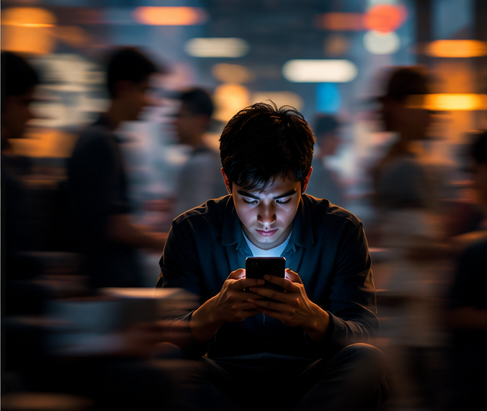
In a virtual world, designed to distract, the attention span of an individual is drastically dipping. The phones in particular are designed to put us in a flow state, however, it’s rarely of a productive kind.
This hyperstimulation whets our appetite to know something more, which may be just a scroll away!
The brain starts functioning on an autopilot state, only being partially aware of the time actually spent. By the end of an hour, most of the things that were seen are compressed as a blur.
The Hippocampus (part of brain, responsible to form memories) absorbs the content that is not fully understood and creates episodic memories.
This is FRAGMENTED ATTENTION! So, a person is rarely fully present anywhere, often waiting for the next digital input. Neurologically, it rewires the brain and it shrinks our thinking center: the cortex
Is our night really a good one?

The pineal gland in our brain secretes the hormone known as melatonin, responsible for circadian rhythm.
Overexposure to screen, tricks our brain into thinking that its day time, even during the wee hours.
A study published in JAMA Network Open, March 2025 concluded that daily screen use was associated with later bedtimes and approximately 50 minutes less sleep each week as observed in the study participants, partly due to screen exposure and partly due to stimulation derived from the social media.
The mind gets wired to be on an alert mode, when it was supposed to relax, waking up unrefreshed.
This actually steals the time, meant to rest, repair and rejuvenate.
Every buzz or notification triggers a micro-stress response—a sharp spike in cortisol. This keeps our nervous system in a low-grade, perpetual "fight-or-flight" state.
The mobile is keeping us under ITS thumb – quiet literally!

In a wake to keep up with the notifications, our very indispensable, opposable thumb completes its workout while scrolling, by the end of the day.
Ironically, a thing you own, ends up owing you!!
Interestingly, a painful condition known as De Quervain’s Syndrome (Texting thumb) is caused by irritation or inflammation of the tendons around the base of thumb.
Conditions like Tech Neck (pain neck and shoulder), Cubital Tunnel Syndrome (Smartphone elbow) are known to develop as Repetitive Strain Injury (RSI).
These prolonged musculoskeletal pains can turn into chronic pain and fatigue syndrome.
The Rewiring
Brain doesn’t know how to distinguish reality from the virtual world. Its absorbing many things but is still malnourished, as its binges on junk! The alert state makes us choose the safe bet.
Addiction is easier than discipline, distraction is easier than focus, stimulation is easier than meaning… but the choice is always ours to make: notifications or nature, Wi-fi or wilderness, screens or sunrises, texting or talking, doom scrolling or dreams waiting to be fulfilled!
Sense and Sensibility:

Undoubtably, digital renaissance is a gift of mankind to itself. Breakthrough discoveries every year are made by many researchers, compounding our knowledge.
But man- the creator, the researcher and the inventor has also to be a protector of his coming generation, treading responsibly, judiciously and ethically.
The good news is that our reason gifted mind possesses an ability to simulate hypothetical futures. We can anticipate possible risks and build defenses against them. And above all, our innate capacity to fill in the gaps with logic!
A fine line is to be drawn while we handle the indispensable digital tools.
Humans can analyze their own thought processes, recognize biases and consciously alter their future behavior.
This allows us to resist base instincts (like immediate gratification) to achieve long-term strategic goals. This is ability to think about the thinking.
As digital world becomes capable of generating text, art and code, human superiority can be preserved through: lived experience, emotional intuition , lateral thinking, creative leaps and physical presence.
It’s time to take the reins in our own hands!
References:
Ali Z, Janarthanan J, Mohan P. Understanding Digital Dementia and Cognitive Impact in the Current Era of the Internet: A Review. Cureus. 2024 Sep 23;16(9):e70029.
Charlie Zong et al, JAMA Network Open Published Online: March 27, 2025;8;(3):e252493
Prachita M Walanker et al, Indian J Occup Environ Med, 2021 Dec 31;25(4):220–224
Comments