


The 10% Restaurant Service Charge: Is It Really Mandatory? CCPA's Crackdown on Restaurants and Cafés in India.


Chandni Barak is a lawyer and partner at Barak Legacy Law Chambers, Mumbai, with 15 years’ experience in AI governance, POSH compliance, and cross-border transactions. She advises startups and established businesses across India.
Website: https://www.baraklegacylaw.com
By Advocate Chandni Barak | Barak Legacy Law Chambers
Beyond Fine Prints
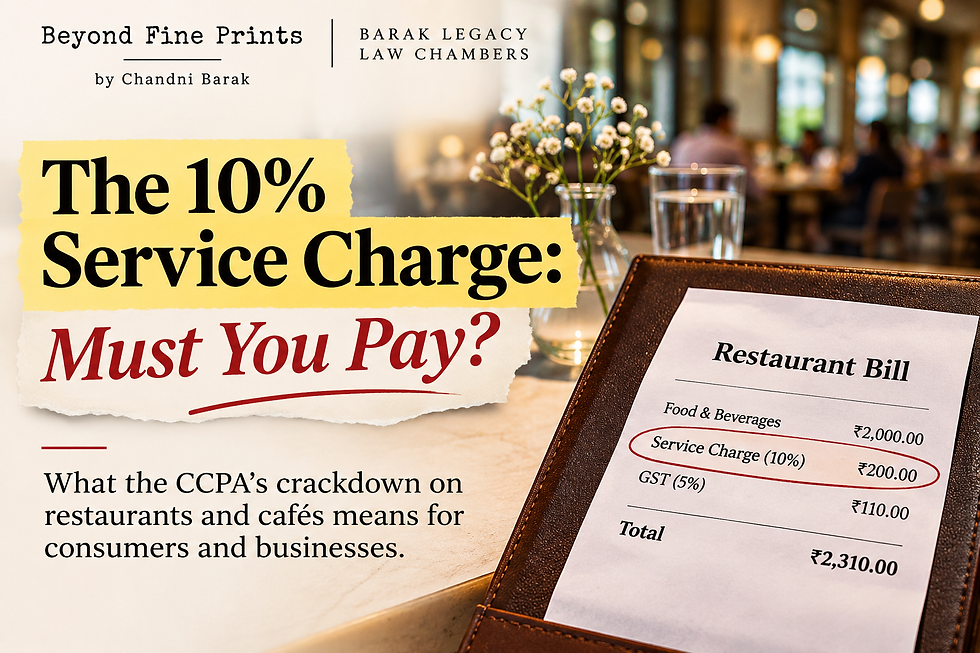
Have you ever visited a restaurant or café, enjoyed your meal, asked for the bill, and noticed an additional 5%, 10% or even 15% service charge added to your total?
You may have questioned it, but perhaps you paid anyway. After all, the restaurant displayed the charge on its menu, and the staff informed you that it was part of the bill.
But is that practice legally permissible?
Can a restaurant automatically add a service charge to your bill? Does displaying it on the menu make it compulsory? Can a customer refuse to pay? And what happens when even established restaurant chains continue to follow such billing practices?
These questions have gained considerable significance following the Central Consumer Protection Authority's (CCPA) enforcement actions against several restaurants and cafés across India.
The issue is not merely about an additional 10% on a restaurant bill. It concerns consumer consent, unfair trade practices and the obligation of businesses to comply with consumer protection laws.
1. What exactly is a restaurant service charge?
A service charge is an amount that restaurants and cafés typically add to the food bill, often as a contribution towards the service provided by their staff.
It is important to distinguish between three different components of a restaurant bill:
Food and beverage charges: The actual prices of the items ordered by the customer.
GST: Applicable statutory tax on restaurant services.
Service charge or tip: A discretionary payment that the consumer may choose to make.
The legal controversy arises when restaurants automatically add a service charge to the bill and expect customers to pay it, irrespective of whether they wish to contribute.
A restaurant is free to determine the prices of its food and beverages. However, it cannot use an automatically imposed service charge to increase the amount payable in a manner prohibited by consumer protection law.
In other words, a business has the freedom to price its products, but that freedom does not extend to imposing a prohibited additional charge on consumers.
2. What do the CCPA guidelines say?
On 4 July 2022, the Central Consumer Protection Authority issued the Guidelines to Prevent Unfair Trade Practices and Protection of Consumer Interest with Regard to Levy of Service Charge in Hotels and Restaurants.
The guidelines were introduced following consumer grievances concerning restaurants and hotels automatically adding service charges to bills without informing customers that payment was voluntary and optional.
The guidelines establish five clear principles:
First: No automatic addition.
No hotel or restaurant shall add a service charge automatically or by default to the food bill.
Second: No collection under another name.
Restaurants cannot circumvent the guidelines by collecting a service charge under another name.
Third: Payment must be voluntary.
No hotel or restaurant can force a consumer to pay a service charge. The consumer must be clearly informed that payment is voluntary, optional and entirely at their discretion.
Fourth: No denial of services.
A restaurant cannot restrict entry or deny services to a customer merely because the customer refuses to pay a service charge.
Fifth: No GST on an added service charge.
A service charge cannot be added to the food bill and then subjected to GST on the combined amount, as provided under the guidelines.
These guidelines establish that a customer should not be compelled to pay a service charge simply because it appears on the restaurant bill.
3. The Delhi High Court settles the legal position
The issue was challenged by restaurant and hotel industry associations before the Delhi High Court in National Restaurant Association of India & Ors. v. Union of India & Anr.
In its judgment dated 28 March 2025, the Court upheld the validity of the CCPA guidelines.
The Court examined whether restaurants could make service charge collection compulsory by relying on the argument that customers were informed about the charge through their menus.
The judgment reinforced that merely displaying a service charge on a menu does not make its compulsory collection legally permissible.
An important distinction exists between a service charge and a voluntary tip or gratuity. A customer should be free to assess the service received and decide whether to make an additional contribution.
The judgment strengthened the regulatory position that restaurants cannot rely on industry practices or internal billing policies to justify making service charges mandatory.
4. CCPA's crackdown: Even well-known restaurant chains are facing penalties
What makes the recent developments particularly noteworthy is that the CCPA's enforcement action is not limited to small restaurants or independent cafés.
Several established names in the hospitality industry have faced regulatory action for automatically adding service charges to customers' bills.
In January 2026, the CCPA initiated action against 27 restaurants, including establishments such as Café Blue Bottle in Patna and Bora Bora in Mumbai.
In the subsequent enforcement developments announced in July 2026, the authority initiated action against another 41 restaurants and confirmed final orders against several establishments.
These included well-known names such as Chaayos, Barbeque Nation, L'Opéra, FOO Ahmedabad and Zorro – The Luxury Night Club. The CCPA also imposed penalties on establishments including Shangri-La Eros, New Delhi, which faced a ₹1 lakh penalty in connection with the service charge levied at its Mister Chai restaurant.
Other reported penalties included ₹50,000 against Chaayos and Bora Bora, ₹30,000 against Café Blue Bottle and ₹20,000 against Curry House CoCo Ichibanya.
The regulatory action is significant for another reason. The CCPA has not restricted its directions to refunding the amount collected from individual complainants.
It has also directed businesses to discontinue the practice and modify their software-generated billing systems to ensure that service charges are not automatically included in customer invoices.
This demonstrates that even established restaurant chains are expected to comply with consumer protection requirements, irrespective of their brand reputation or scale of operations.
5. Why does an automatically added service charge amount to an unfair trade practice?
The legal issue goes beyond whether a customer can eventually request a refund.
Under Section 2(47) of the Consumer Protection Act, 2019, unfair trade practices are prohibited.
When a restaurant automatically adds a service charge to a bill, several consumer rights concerns arise:
Lack of informed consent: The customer may be led to believe that the charge is compulsory.
Misrepresentation of the final price: The amount displayed on the menu may not reflect the actual amount the customer is expected to pay.
Unfair burden on consumers: The customer is required to object, negotiate or seek removal of a charge that should not have been automatically imposed.
Potential misleading representation: Describing a charge as optional while embedding it in the billing software may create a misleading impression about the customer's actual payment obligation.
The CCPA's enforcement actions indicate that merely changing the description of a charge to "optional", "staff contribution" or "discretionary" may not be sufficient if the underlying billing mechanism continues to add it by default.
The substance of the transaction matters.
6. What should restaurants and cafés do to remain compliant?
For restaurant owners, café operators and hospitality businesses, these developments should serve as a compliance warning.
The following measures deserve attention:
Review billing software: Ensure that service charges are not automatically included in customer invoices.
Review menus and customer disclosures: Remove wording that suggests a service charge is compulsory.
Review staff contribution policies: Do not use alternative descriptions to circumvent the CCPA guidelines.
Train employees: Ensure that staff understand that customers cannot be pressured into paying service charges.
Review GST treatment: Ensure that the billing and tax treatment complies with applicable guidelines and tax law.
Establish grievance redressal mechanisms: Maintain functional customer support channels and address billing complaints promptly.
Review practices across outlets: For restaurant chains, compliance must extend to every outlet and every software-generated invoice.
A restaurant may have hundreds of outlets, but the legal obligation to comply remains the same.
7. What can consumers do if a service charge is imposed?
Consumers do not have to remain silent when they encounter an automatically added service charge.
Here are some practical steps:
Request the restaurant to remove the service charge from the bill.
Preserve the itemised invoice and, where relevant, photographs of the menu or other representations made by the restaurant.
If the restaurant refuses to remove the charge, lodge a complaint with the National Consumer Helpline.
Consumers can contact the NCH through its toll-free number 1915 or its official online platform.
A consumer may also approach the appropriate Consumer Commission for relief, depending on the facts and circumstances.
The CCPA guidelines also provide for complaints to the District Collector for investigation and subsequent proceedings by the CCPA.
8. The larger lesson: A voluntary tip cannot become a compulsory billing practice
The recent CCPA orders send a clear message to the hospitality industry.
Restaurants have the commercial freedom to determine their menu prices. They may also receive voluntary tips or contributions from customers.
However, they cannot convert a discretionary payment into a compulsory component of the bill through default billing, software settings or alternative terminology.
For consumers, the takeaway is simple: You are not legally required to pay an automatically imposed service charge merely because it appears on your restaurant bill.
For businesses, the message is equally important: compliance cannot be achieved merely by printing the word "optional" on a menu while continuing to add the charge automatically.
The real test is whether the customer has a genuine choice.
As the restaurant industry continues to grow, transparent pricing and fair billing practices must become an integral part of responsible business conduct.
A customer's right to know what they are paying for is not a matter of courtesy. It is a matter of consumer protection.
Barak Legacy Law Chambers | Advocate Chandni Barak
Beyond Fine Prints
Understanding the law, one everyday issue at a time.
Comments